The Pavement Playlist: Who's Actually Choosing What You Hear on the High Road
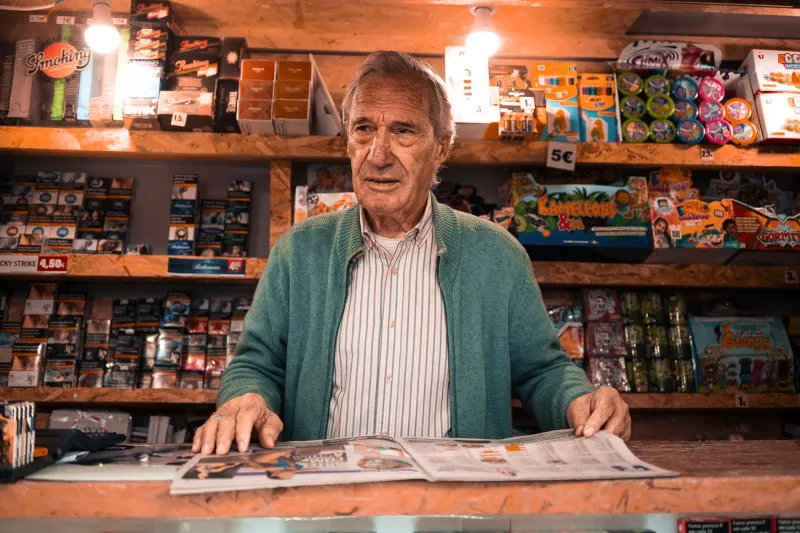
There's a point on the Uxbridge Road, somewhere between the launderette and the secondhand phone shop, where you can stand still and hear three different radio stations at once. Not loudly. Not competing, exactly. Just layered — one drifting out of a barber's open door, another leaking through the glass of a newsagent, a third coming from somewhere behind a stack of cardboard boxes. For about fifteen metres you're inside a broadcast nobody planned and nobody is selling advertising against.
We spent a fortnight doing something slightly odd: walking West London's high roads slowly, stopping at doorways, and listening. Acton, Southall, Harrow Road, Goldhawk Road, Northfields Avenue. It turns out the corner-shop radio is the most honest local station in the city, and almost nobody is talking about it.
The Dial Is a Personality Test
Ask a shopkeeper why they've got the radio on and you'll usually get a shrug. Ask them what they've got it on and the shrug disappears.
"It's not for me, it's for them," said one barber on Acton High Street, nodding at the empty chairs. "They come in, they hear something familiar, they sit down. If it's quiet music they get nervous. If it's talk they join in."
That's the whole commissioning brief, really. Barbers lean towards speech and phone-ins, because silence in a barber's is unbearable and a caller being gently wrong about something is the cheapest icebreaker going. Newsagents skew towards music with ad breaks, since a shop where the till is the main event needs a rhythm. Cafés — the good ones — go quiet and acoustic in the morning and something with a bit of brass by eleven.
And the hardware shops? They've mostly stopped pretending and just leave it on the same station their dad had it on. Nobody has ever asked them to change.
Shutters Up, Volume Down
The first hour is the gentlest. Between seven and eight, the sound on a high road is mostly shutters, deliveries and one radio turned low behind a counter while somebody counts a float. Shopkeepers are protective of that hour — the station playing is often the only other voice in the building.
By half nine the mix thickens. Two or three shops within earshot land on the same station by accident, and something strange happens: the pavement acquires a soundtrack with actual continuity. You'll walk past a phone repair place, a florist and a dry cleaner and hear the same record in three degrees of muffling, like a song moving through walls.
That accidental sync is why some traders quietly coordinate. Not formally — nobody's having a meeting about it — but a few have worked out that if the whole parade is on the same station, the street feels busier than it is. On a wet Tuesday in February, that matters.
The Four O'Clock Problem
There's an unwritten rule about volume, and it gets broken daily around four.
One shop turns up because the afternoon lull is brutal and the radio is doing the work of a second member of staff. The neighbour turns up to compete. Twenty minutes later the parade sounds like a school disco heard through a wall, and somebody has to go and have a word. Usually it's the pharmacist, because pharmacists are the diplomats of the high road.
"I don't mind the music," one told us, "I mind that I can't hear the customer."
That's the real constraint. Shop radio only works while it stays underneath the job. The moment a customer has to raise their voice to be served, the broadcast has failed — not as entertainment, but as shopkeeping.
Where the Noticeboard Went
Something else has happened to these radios, and it's the part worth paying attention to.
Local news for a lot of West London doesn't arrive by newspaper any more. It arrives through a shop radio at ten past eleven, or through a phone-in at nine, or through a two-minute ad break that tells you the market's running late and the road's shut at the top end. Traders listen to that stuff because it's operationally useful. Customers overhear it because they're standing at a counter waiting for a receipt.
That's a hyperlocal broadcast doing exactly what the name promises — narrow, immediate, and completely embedded in a place. It's also, for a lot of people, the only local news they get all week that isn't about somewhere else.
Tuning In as You Walk
The nice thing is you don't need a licence, an aerial or even a phone to join in. You just have to slow down.
Try it on a Saturday morning. Start at the top of the road, walk the length of it at half your normal pace, and count how many different stations you pass. You'll get a barber, a bakery, a betting shop, a grocer, and at least one place where the radio is on in a back room and the door is open just enough to let it out.
Nobody will notice you listening. Nobody is broadcasting to you, technically. But stand at the right doorway for a minute and you'll hear the street explain itself — what's open, who's around, what happened last night, whether the match is worth watching.
The hum of the high road isn't background noise. It's a network, and it's been running the whole time.