Mic Left Open: The West London Standby Hosts Who Turn a Cancelled Guest Into Radio
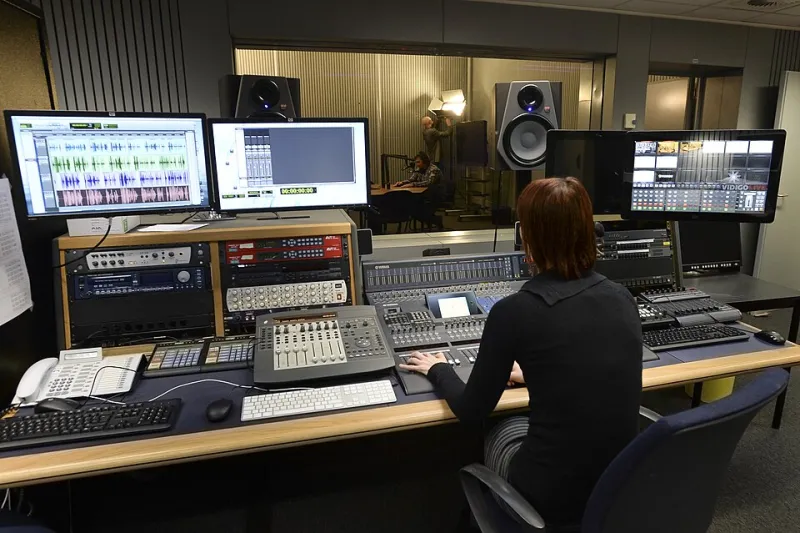
Photo: Europäische Kommission - Audiovisueller Dienst, Etienne Ansotte, CE - Service audiovisuel, EC - Audiovisual Service, Shimera, CC BY 4.0, via Wikimedia Commons
At 7.42pm on a damp November evening in 2026, a community studio somewhere between Acton and Ealing is one guest short. The scheduled historian — booked to talk about a lost cinema on the Uxbridge Road — is stuck behind a signal failure on the Piccadilly line. The producer has already sent the bad news by text. The host, who has been on air for eleven minutes, does not panic. She reaches for the standby folder, takes a breath, and says the words that have saved more West London radio hours than any script: 'We've had a change of plan.'
That is not dead air. That is live wire.
The standby folder
Most community stations in West London do not have a formal understudy system. They have something better and messier: a standby list. It might be a laminated sheet taped inside a cupboard, a shared spreadsheet with too many tabs, or a WhatsApp group called something like 'Spare Voices'. The names on it are not celebrities. They are volunteers who can talk about the borough without reading from a press release.
The list exists because community radio runs on goodwill and bus timetables. Guests cancel. Guests get lost. Guests say yes in September and forget by November. A live feed from a community centre fails because someone has unplugged the router to boil a kettle. A pre-recorded interview turns out to be unplayable. In a volunteer-run station, these are not exceptional events. They are Tuesday.
The trick is not to pretend nothing has happened. The trick is to make the gap part of the programme. A good host will tell listeners there is a change of plan, explain why if it is funny, and then move on. The audience is not stupid. They can hear when a show is stalling. What they cannot resist is a host who sounds like a human being dealing with a human problem.
When the guest is a no-show
The first minute after a cancellation is the most important. The mic is open, the clock is running, and the host has to decide what kind of hour this is going to be. Some reach for music. Some reach for the phone lines. Some reach for the traffic and travel, even when they have already read it twice.
The best standby hosts have a small bag of tricks. Three stories about the local area. Two phone numbers for people who will almost always pick up. One song that can fill four minutes without sounding like a panic button. A time check. A station ident. A reminder of what is coming up later. None of it is glamorous. All of it is radio.
There is a craft to it, too. Filling time is not the same as filling silence. A host who talks non-stop for twelve minutes is not doing anyone a favour. A host who asks a caller one good question and then lets the answer breathe is doing the job. The gap is not a hole to be stuffed. It is a room to be rearranged.
Callers as accidental co-hosts
The phone line is the standby host's secret weapon. In West London, the regular callers are a kind of unofficial repertory company. There is the man who rings about parking on the Broadway. The woman who knows which bakery opens earliest. The taxi driver with opinions about the A40. The retired teacher who can date every shop that has ever stood on the High Street.
On a normal show, these callers are a garnish. On a standby show, they are the main course. A caller can buy you seven minutes and give you the next three. They can turn a cancelled interview into a conversation about the thing listeners actually care about: the roadworks, the bus route, the market stall that has changed hands, the cinema that closed before anyone thought to photograph it.
That is hyperlocal radio at its best. It is not polished. It is not predictable. It is a station admitting that the plan has changed and inviting the audience to help write the new one.
The art of the unplanned hour
Improvisation is not the same as carelessness. Community radio still has a licence to protect and a responsibility to get things right. A standby host cannot simply say anything that comes into their head. They need to know when to hand back to the news, when to read the weather, when to play the sponsor message, and when to stop talking.
The good ones also know how to end. An unplanned hour can drift. A host who has been filling time for forty minutes can forget that the listener has joined late and has no idea what is going on. The best fillers recap. They signpost. They say 'if you've just tuned in, we were meant to be talking about...' and then they make the new thing sound deliberate.
There is a quiet skill in that. It is the same skill that keeps a market trader talking through a slow morning, or a launderette owner making conversation while the spin cycle runs. West London is full of people who can hold a room without a script. Community radio is one of the few places where that skill gets a microphone.
Why the gaps matter
National radio can hide a missing guest behind a pre-recorded interview or a carefully timed playlist. A West London community station cannot. Its listeners know the roads being discussed. They know the shop that has closed. They know the bus that never turns up. The station's credibility depends on being close enough to the ground that a cancellation feels like a shared inconvenience rather than a technical fault.
That is why the standby list matters. It is not just a contingency plan. It is a statement of intent. It says that the station would rather be live and slightly chaotic than smooth and empty. It says that the people behind the mic are part of the same neighbourhood as the people listening.
So if you tune in on a wet November night and hear a host say, 'We were meant to have a guest, but they're stuck on the Piccadilly line' — stay with it. You are not hearing a failure. You are hearing the station at its most honest, and often at its most memorable. Dead air is the enemy. A live wire is the point.