A Mixer in the Boot: West London Radio That Comes to the Day Room
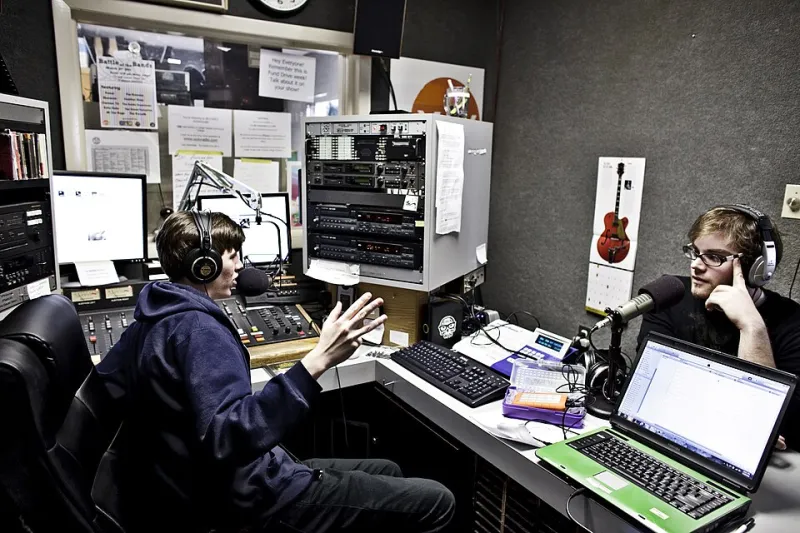
Photo: Lehigh Carbon Community College, CC BY-SA 3.0, via Wikimedia Commons
There is a particular sound to a radio session that has been unpacked from a bag. First comes the zip, then the soft thump of a mixer being set down on a laminate table, then the pause while someone works out which socket goes where. In a studio, those noises are hidden behind soundproofing and routine. In a care home lounge in Ealing, or a hospital day room near Hammersmith, they are part of the show.
Across West London, a loose network of community radio volunteers has been quietly building a different kind of outside broadcast. Instead of waiting for listeners to ring in or turn up, they take the kit to people who cannot easily get to a studio: residents in sheltered housing, patients between appointments, carers who cannot leave the building, and older listeners for whom a bus journey across the borough is now a major expedition.
The case itself is not glamorous. Think sturdy wheeled luggage rather than a sleek flight case, with a small mixer, a couple of microphones, a tablet for backing tracks, a tangle of cables, a notebook of cue points and a folder of request slips. Some volunteers add large-print lyric sheets, a spare pair of reading glasses and a packet of wipes. One producer describes it as “a radio station that fits in the boot of a hatchback, as long as nobody brings the good speakers.”
Packing light, listening close
The sessions are not simply mobile karaoke hours or a bit of background music. The best of them are built around conversation, memory and the small details that make a local station feel local. A volunteer might arrive with a list of songs suggested by residents the week before, then spend the first twenty minutes asking who chose what and why. The answers often wander. A request for a 1960s ballad turns into a story about a first dance in Southall. A favourite brass band number leads to a memory of a works outing from Brentford. Someone mentions a market stall, a old school friend, a pub that is now a block of flats.
That is the raw material. Some of it goes out live on a community frequency or online stream. Some is recorded and edited later into a slower, more crafted programme. Either way, the aim is the same: to make the room sound like part of West London rather than a place set apart from it.
“You are not there to interview people,” says one volunteer who has been running sessions in Hounslow and Richmond for several years. “You are there to have a conversation that happens to have a microphone in it. If it feels like a broadcast, that is because someone is listening. But it has to feel like a visit first.”
The request slip as a door
The request slip is a modest piece of paper, usually A5, sometimes printed in large type. It asks for a name, a song and a line about why it matters. Volunteers leave a stack behind after each visit and collect them on the next. The slips are not just a playlist generator. They are a way of giving people a reason to speak, and a reason for the station to come back.
In one sheltered housing scheme near Acton, the folder has become a kind of informal archive. Residents add notes in the margins: “the version with the trumpet,” “not the sad one,” “for Doreen, who used to work at the cinema.” A volunteer reads them out between tracks, careful with pronunciations and quick to apologise when a surname is wrong. The result is a programme that sounds like a street or a block of flats rather than a demographic.
This is hyperlocal radio at its most literal. The signal may travel across half of West London, but the listening is concentrated in one room. The show is not trying to speak to everyone. It is trying to speak to the people in front of the microphone, and to anyone else who recognises the world they are describing.
When the room changes the show
Studio radio is built on control. The clock is tight, the levels are set, the guest is briefed. A day-room session is built on negotiation. The tea trolley arrives halfway through a story. Someone needs the loo. A television in the corner is still murmuring until a carer switches it off. A resident who was enthusiastic about singing decides, at the last moment, that they would rather listen.
The volunteers learn to build those interruptions into the format. A dropped line becomes a joke. A request that cannot be found becomes a discussion about the version someone remembers instead. A resident who does not want to speak on mic can still choose the next record, or hold the request slip, or simply nod along. The programme bends around the room rather than asking the room to bend around the programme.
That flexibility matters. It also makes for better radio than a polished segment that has been rehearsed to death. The listener at home can hear that this is a real place with a ticking clock and a slightly unreliable radiator. In a media landscape full of smooth, identical voices, that imperfection is a form of local knowledge.
Why it matters more than the signal
Community radio is often judged by reach: how many listeners, how many hours, how many posts on social media. The day-room sessions suggest another measure. Did someone who rarely leaves their building get to hear their own street mentioned on air? Did a carer get ten minutes of music that was chosen for them rather than around them? Did a request slip turn into a conversation that would not otherwise have happened?
Those outcomes are hard to count, but they are easy to recognise. They are also why the volunteers keep hauling the case into the boot of a car on a wet November morning. The studio is important, but it is not the only place where radio happens. Sometimes the transmitter is a small mixer on a table, the audience is eight people in armchairs, and the most local thing you can do is turn up.
FM West will keep an eye on these mobile sessions as they move around the boroughs this winter. If you know a day room, a sheltered housing lounge or a hospital waiting area that could do with a visit, the request slip is still the best place to start. You do not need a good singing voice. You just need a song and a reason.