Solder, Patience and a Dial That Still Turns: West London's Radio Fixers
On a damp Saturday morning in Acton, the queue outside the church hall is not for a pop-up bakery or a record fair. It is for a Roberts radio with a snapped aerial, a Bush transistor set that has not made a sound since the kitchen was redecorated, and a Grundig that smells faintly of a cupboard in Hanwell. This is a monthly repair café, one of a handful across West London where volunteers give old radios another go.
The format is simple. You bring the set. A volunteer asks what it does and what it does not do. Then comes the careful business of opening it up, testing, cleaning, and sometimes admitting that the fault is beyond the table. No one pretends every radio can be saved. The point is to try. For FM West, this is local culture at its most practical: a room full of people refusing to throw something away before they have had a proper look.
The table where radios come back
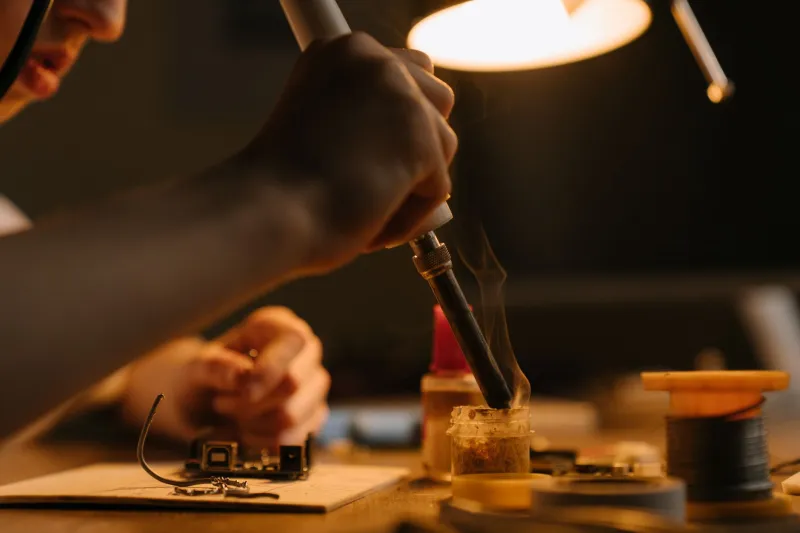
The tables are laid out like a small workshop: multimeters, soldering irons, screwdrivers in tidy rows, a tin of assorted capacitors, and a power strip that has seen things. There is coffee. There is usually a biscuit tin. There is the warm, faintly metallic smell of solder and dust meeting a hot tip.
The fixers are a mixed bunch. A retired engineer from Ealing who can read a circuit diagram the way other people read a bus timetable. A former broadcast technician from Shepherd's Bush who keeps saying the trouble is almost always the switch. A younger maker from Brentford who learned their way around a soldering iron on YouTube and is now the person everyone asks about aerials. Between them they have a rule: listen first, then test, then decide.
A radio is a surprisingly emotional object. People arrive with stories attached. One woman from Southall brings a set that belonged to her mother. It has a stiff dial and a speaker that crackles when the volume is turned. She does not need it for the news. She needs it for the sound of a voice in the kitchen. A man from Chiswick has a transistor set he took to university. It has been in a loft for years. He wants to know if it will still pick up a local station. The answer, after a clean of the battery contacts and a new aerial, is yes.
Why the old sets still matter
Analogue radios are not efficient. They are not smart. They do not update themselves overnight or ask for a password. That is partly the point. A dial has a beginning and an end. You turn it, you find a station, you hear something you did not plan to hear. In a house full of disposable Bluetooth speakers, that small act of searching feels almost radical.
There is also the sound. A well-made old set has a warmth that is hard to describe without sounding like a wine label. It is not better than a modern radio in every way. It is different. For listeners who grew up with local radio in the background, that difference matters. It is the sound of a kitchen, a shed, a car that has seen better days.
And there is the practical point. Community radio in West London is still, for many people, a dial away. Not everyone wants to listen through a phone. Not everyone can. A working FM set is a cheap, sturdy route to local voices, local music and the sort of notices that do not always make it online. Repairing one is a small act of keeping that culture audible.
What a session actually sounds like
It is not a silent library. A repair café hums. Test tones come and go. Someone is explaining a capacitor. Someone else is laughing at a radio that suddenly bursts into life with a weather forecast. A volunteer leans in to hear a faint station under the interference. The owner leans in too. For a moment the whole table is quiet, listening to a signal that has travelled further than anyone in the room.
Then the set is put back together. Screws go into a little dish. The case is wiped. The aerial is straightened. The radio is switched on again, and the room waits. Sometimes there is nothing. Sometimes there is a crackle. Sometimes there is a voice, clear enough to make someone put a hand to their mouth. That is the moment the volunteers keep coming back for.
The fixers are careful about safety. Anything with a mains lead gets checked. Anything that looks beyond repair is left alone. They will not promise a miracle, and they will not take on a set that is going to be dangerous. But they will explain what is wrong, what it would take, and whether it is worth it. That honesty is part of the service. It is also part of the pleasure.
Where to find a second chance
Repair cafés run across West London, often monthly, in church halls, community centres and libraries. You will hear about them on noticeboards, from neighbours, and occasionally on the radio itself. Ealing, Acton, Chiswick, Hanwell, Shepherd's Bush, Southall and Brentford all have versions of the same idea. Some ask for a small donation. Some have a waiting list. Most ask you to bring the whole radio, not just the plug.
It helps to arrive with a clear idea of what the set is doing. Does it power on? Is the dial stiff? Does it only crackle on AM? Has it been in a damp cupboard? The volunteers are not magicians, but they are good at narrowing things down. And if they cannot fix it, they will usually tell you where to look next.
The second chance is mutual
The owners get a radio back. The volunteers get something too. They get to use skills that do not always have a place in everyday life. They get to teach. They get to sit with a problem until it makes sense. Younger fixers learn from older ones. Older ones learn that a YouTube tutorial is not the enemy. The whole thing is a small, practical exchange of time and knowledge.
That is why these sessions feel like more than a hobby. They are a quiet counterargument to the idea that everything old is rubbish and everything new is better. They keep a few hundred radios out of the waste stream, yes. But they also keep a habit alive: the habit of listening locally, of turning a dial, of finding a station that is not chosen by an algorithm.
If you have a dusty set in the loft, this November might be the month to bring it in. You do not need to know what is wrong with it. You just need to turn up, put it on the table, and let someone have a look. The worst that can happen is that it stays broken. The best is that a voice comes back into the kitchen.